Balkan news without the globalist spin


Please Follow us on Gab, Minds, Telegram, Rumble, Truth Social, Gettr, X, Youtube, Instagram
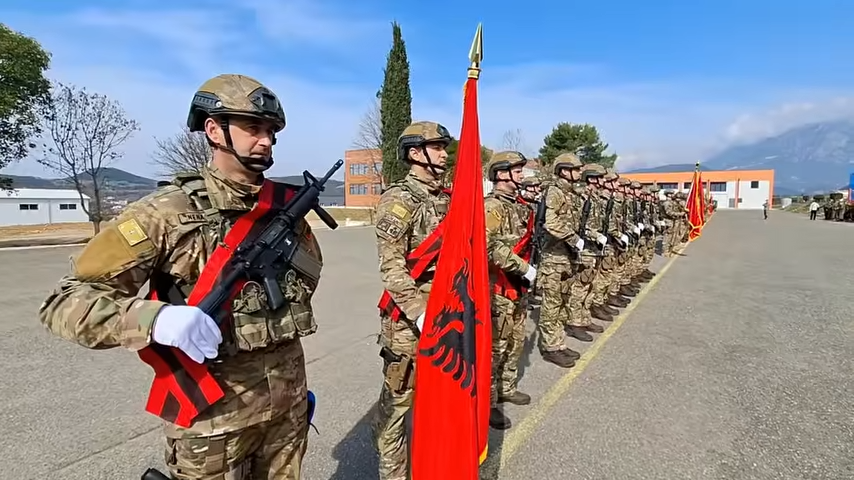
The approval by the U.S. State Department in November 2026 of a possible sale of two M142 HIMARS systems to the Republic of Albania, in a package valued at $210 million, is not an isolated technical event in the field of military cooperation. It represents a symbolically and operationally significant step in a process that has for years been reshaping the strategic architecture of the Western Balkans. The package includes 72 guided GMLRS rockets (with a range of over 70 km, in practice up to around 90 km), tactical fire-control systems, training, and logistical support, financed through a U.S. Foreign Military Financing (FMF) loan. The principal contractor is Lockheed Martin. With this acquisition, Albania obtains for the first time a modern long-range precision-strike capability that it previously lacked.
When this move is viewed in a broader context, it becomes clear that it forms part of a coordinated process of strengthening the military capacities of Albania and so-called Kosovo, alongside the parallel arming of Croatia and certain structures within the Federation of Bosnia and Herzegovina. Kosovo, whose unilateral declaration of independence in 2008 remains outside the framework of international law (in the sense of the absence of United Nations Security Council consent and the violation of Resolution 1244), has continuously increased its defense budget and acquired anti-tank systems (Javelin), drones (Bayraktar TB2 and others), mobile artillery, and armored vehicles. Albania is modernizing its forces through NATO channels, while Croatia is procuring HIMARS systems as well as South Korean Chunmoo systems. Declarations on defense cooperation between Albania, Croatia, and Pristina further institutionalize this collaboration.
Serbia remains the militarily strongest state in the Western Balkans. It possesses the largest and most comprehensive inventory of tanks, self-propelled artillery (including the indigenous Nora B-52 systems), multiple-launch rocket systems, and a developed defense industry. Modernization of its air force is also underway (the contract for Rafale aircraft). Precisely because of this relative advantage, the process of arming neighboring states and the formation of an informal axis — Albania, so-called Kosovo, Croatia, together with certain structures of the Federation of BiH — creates the impression of a systematic attempt to neutralize or at least constrain that advantage. All of this is unfolding in the context of the unresolved status of Kosovo and Metohija, where Belgrade continues, on the basis of international law, to regard that territory as part of its sovereignty.
The U.S. State Department formally asserts that the sale of HIMARS “will not alter the basic military balance in the region.” From the standpoint of classical geostrategy and the history of the Balkans, such an assessment appears as a diplomatic formula that overlooks the cumulative effect. Precision firepower with a range exceeding 70 km in Albanian hands, combined with the strengthening of Kosovo’s forces and Croatian capabilities, changes the calculations of deterrence. Under conditions of unresolved ethnic and territorial issues, any significant strengthening of one side is automatically perceived as a threat by the other.
Thus a new line of division is slowly taking shape in the Balkans. One side relies on the NATO framework and Western arms deliveries; the other seeks to maintain strategic autonomy and its own capabilities. This is no longer the classic arms race of the 1990s, but a process that recalls the beginnings of the Cold War — with the formation of informal blocs, rising military spending, propagandistic narratives, and mutual distrust. The history of the region shows that such processes rarely remain “cold” forever. Under conditions of economic vulnerability, demographic pressures, and unresolved status questions, the risk of escalation into open conflict is not negligible.
From a university perspective, this development confirms an old truth of geostrategy: in a space where the interests of great powers intersect and where ethnic boundaries remain contested, the military strengthening of one side without parallel political de-escalation and resolution of the root problems inevitably disrupts the balance. HIMARS in Albania is not the cause, but a symptom of a deeper process. If that process continues without serious dialogue and respect for international law regarding Kosovo and Metohija, the Balkans could in the coming years face a scenario that will no longer be merely “cold.”


Stay informed with The Balkan